
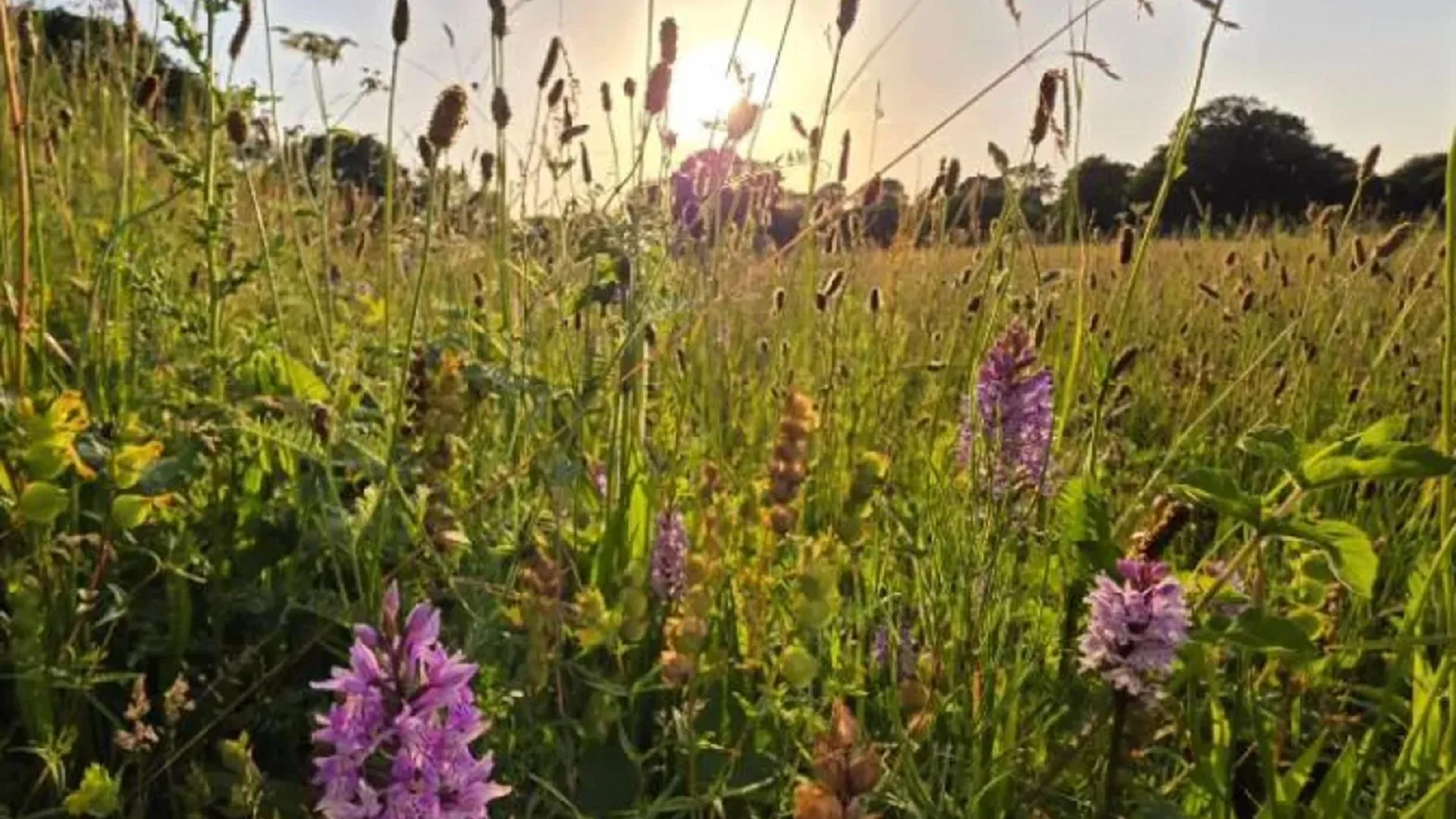
Research led by Professor Carl Sayer at UCL Geography has found that abandoned farmland can recover naturally and develop into a diverse wildflower meadow, raising questions about some conventional methods used in habitat restoration.
Published in Restoration Ecology, the research followed changes in plant life over 11 years (2011-2022) in a two-hectare field in North Norfolk. Farming at the site ended after its final crop in 2005. Aside from a traditional annual hay cut, the field was largely allowed to recover without intervention.
Farmland Transforms Into a Wildflower Meadow
Within 10-15 years, the former arable field had developed into a species-rich wildflower meadow. The number and variety of plants increased over time, including locally rare species such as southern marsh orchid, greater tussock-sedge, yellow rattle and common centaury.
The results call into question the common assumption that restoring species-rich grassland necessarily requires commercial seed mixes or other expensive measures. Instead, the researchers suggest that allowing natural ecological processes to unfold can restore biodiversity while also preserving the genetic diversity of plants already adapted to the local area.
Carl Sayer, Professor of Limnology and Freshwater Ecology, said, "Our study shows that resisting seeding and allowing nature to lead may be worth trying a lot more in wildflower meadow restoration. Natural plant recovery better safeguards genetic diversity than seeding and ensures that local species thrive, making meadows less generic. As things stand the UK needs nature recovery fast, at big scales. In the push to achieve this goal our study poses the question: should we be employing patience over seed packet more often?"
The findings arrive as governments throughout the UK and Europe search for effective ways to restore biodiversity across large areas of former farmland. Species-rich grasslands offer important habitat for pollinating insects, birds and mammals. They can also strengthen ecosystem resilience and help landscapes adapt to climate change.
Tracking Natural Meadow Recovery Over 11 Years
Long-term ecological studies examining the natural restoration of grasslands are uncommon because they depend on consistent monitoring over many years.
The study focused on Sayer's Meadow in Bodham, North Norfolk. The land is owned by Professor Sayer's father and co-author Derek Sayer. Every two to three years, Professor Sayer and collaborator Pete Robinson conducted detailed vegetation surveys. They recorded every plant species identified across the meadow and tracked changes within permanent survey plots.
During the study period, the average number of plant species found in each survey plot doubled. The figure rose from about 10 species in 2011 to nearly 20 by 2022.
As the meadow developed, thousands of orchids became established naturally. Populations of yellow rattle also increased. Both are considered indicators of successful meadow restoration.
Wildlife May Have Helped Plants Return
The researchers think some of the site's more unusual plants may have arrived without human assistance, possibly carried or dispersed by wildlife such as deer. Their appearance highlights the ability of landscapes to regenerate when natural ecological processes are given enough time to operate.
Reflecting on the project, Professor Sayer said:
"The field belongs to my family, and after an oilseed rape crop in 2005 we stopped farming it as the land was difficult to drain. I really wanted a wildflower meadow and all advice was to seed it, but I resisted the temptation, as I have always been interested in nature's ability to recover itself.
"When the first orchids started appearing in our surveys, we were thrilled and now the meadow is unbelievably diverse, with thousands of orchids that delight locals in the village. Our study shows what can be achieved by a traditional hay cutting approach combined with nature's brilliant spontaneity. A visit to the meadow is like stepping back through time."
A Simpler Approach to Biodiversity Restoration
The research shows how geographical studies can help shape practical strategies for restoring damaged landscapes. It provides evidence that nature-led recovery could contribute significantly to biodiversity restoration goals while lowering both the cost and complexity associated with bringing degraded land back to ecological health.
Story Source:
Materials provided by University College London (UCL). Note: Content may be edited for style and length.
Journal Reference:
- Carl D. Sayer, Peter Robinson, Derek C. G. Sayer, Jan C. Axmacher. No need to seed: restoring species‐rich grassland on former arable fields by natural regeneration. Restoration Ecology, 2026; DOI: 10.1111/rec.70487
Cite This Page:
University College London (UCL). "Scientists left this farm field alone. Thousands of orchids appeared." ScienceDaily. ScienceDaily, 23 August 2026. . University College London (UCL). (2026, August 23). Scientists left this farm field alone. Thousands of orchids appeared. ScienceDaily. Retrieved August 23, 2026 from www.sciencedaily.com/releases/2026/08/260822015208.htm University College London (UCL). "Scientists left this farm field alone. Thousands of orchids appeared." ScienceDaily. www.sciencedaily.com/releases/2026/08/260822015208.htm (accessed August 23, 2026).Explore More
from ScienceDaily RELATED STORIES Scientists Discover Orchids Sprouting from Decaying Wood Oct. 8, 2025 Kobe University researchers found that orchids rely on wood-decaying fungi to germinate, feeding on the carbon from rotting logs. Their seedlings only grow near deadwood, forming precise fungal ... Fungi-Eating Plants and Flies Team Up for Reproduction Aug. 24, 2023 Fungi-eating orchids were found for the first time to offer their flowers to fungi-eating fruit flies in exchange for pollination, which is the first evidence for nursery pollination in orchids. This ... Wind Farm Noise Exposure Doesn't Wake People Up from Their Slumber More Than Road Traffic Noise June 26, 2023 Short exposure to wind farm and road traffic noise triggers a small increase in people waking from their slumber that can fragment their sleep patterns, according to new research. But importantly, ... A World Map of Plant Diversity Nov. 15, 2022 Why are there more plant species in some places than in others? Why is diversity highest in the tropics? What is the connection between biodiversity and environmental conditions? To help answer these ... New Study Shows the Toll Industrial Farming Takes on Bird Diversity Jan. 12, 2022 A new study looking into the impacts that large industrial farming has on biodiversity found that increased farm size causes a decline in bird diversity. Researchers studied how different farming ... Himalayan Bats Are Functionally Less Diverse at High Than at Lower Elevations, but Show the Same Evolutionary Diversity Nov. 24, 2021 Million years of evolution have produced a dazzling variety of species, each uniquely adapted to its environment. A straightforward way to measuring biodiversity is by the number of species ... TRENDING AT SCITECHDAILY.comA 47-Year-Old Scientist Tracked Himself for Months – His Biological Age Fell to 32
Astronomers Detect a Record-Breaking “Cosmic Laser” From 8 Billion Light-Years Away
Almost All Plant-Based Meat Alternatives Contain Mycotoxins, Study Finds
Just 4 Minutes of Daily Strength Training Can Quadruple Fitness in Older Adults
Print Email ShareBreaking
this hour- A Tiny Big Bang Leaves a Strange Clue
- A Hidden “On Switch” in Human DNA
- Burn Fat Without Losing Muscle
- Vitamin D Linked to Better Cognition
- Black Holes Keep Tearing These Stars Apart
- 400-Year-Old Shark Eyes Defy Aging
- Speaking More Languages May Slow Aging
- JWST Finds Hidden Mass in Early Galaxies
- Natural Supplement May Boost Cancer Immunity
- Queen Bees Pass Pesticides to Their Eggs
Trending Topics
this week PLANTS & ANIMALS Food Food and Agriculture Behavioral Science EARTH & CLIMATE Ecology Geography Air Quality FOSSILS & RUINS Origin of Life Ancient Civilizations Lost TreasuresStrange & Offbeat
PLANTS & ANIMALS This Shark Can Live 400 Years. Its Eyes Barely Seem to Age “One-in-a-Million” Sea Creature Fossil Preserves Soft Tissue for 450 Million Years This 23-Foot Crocodylian May Have Ruled South America’s Food Chain EARTH & CLIMATE A Lost Mega-Cliff May Explain the Grand Canyon’s Missing Billion Years Meteorite That Smashed Through a New Jersey Roof Reveals Clues to Life’s Origins These Underwater Bones Could Solve a Mystery About Extinct Giants FOSSILS & RUINS Paleontology Rocked by Organic Molecules Found in 66-Million-Year-Old Dinosaur Bones Scientists Find Evidence for Two Origins of Life on Earth The Dodo Bird Had a Secret Sensory World Scientists Are Only Now Discovering\n