
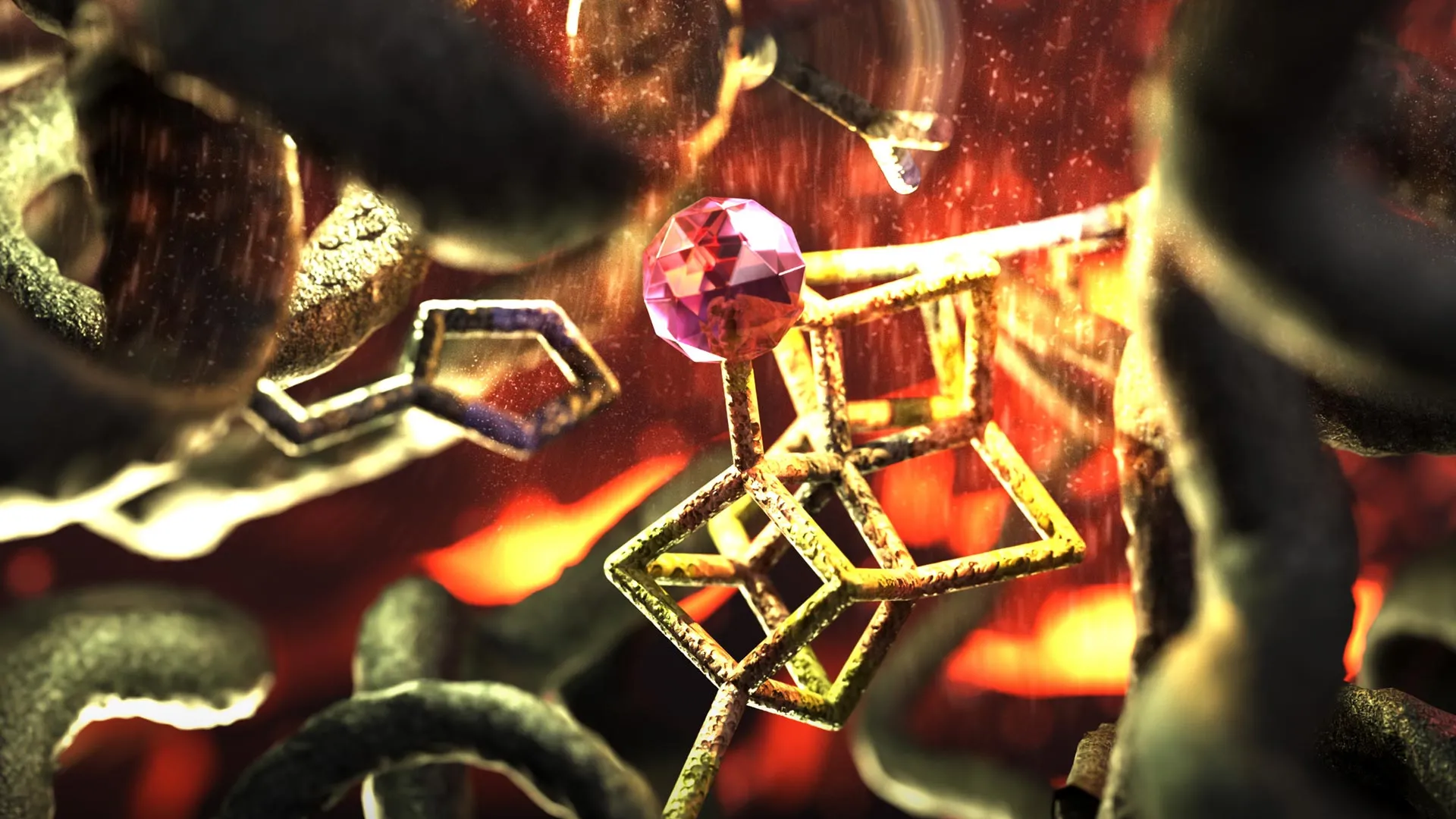
Microorganisms are capable of some extraordinary chemistry. One example is nitrogen fixation, a process that converts nitrogen gas (N2) into a form living organisms can actually use. Nitrogen makes up about 78 percent of Earth's atmosphere, but plants and animals cannot use it directly because the two nitrogen atoms in N2 are joined by an exceptionally strong chemical triple bond.
Certain microorganisms have evolved a way around this problem. They can break that bond and transform N2 into ammonia, which can then be incorporated into biological molecules. One of these organisms is the deep-sea archaeon Methanocaldococcus infernus, which lives in volcanic marine environments where vent fluids can reach temperatures above the boiling point of water.
Researchers in Tristan Wagner's laboratory at the Max Planck Institute for Marine Microbiology in Bremen wanted to understand how this organism performs nitrogen fixation under such extreme conditions. They managed to "tame" the microbe in the laboratory and make it fix N2 at temperatures above 90 °C.
"How do they do it, in such heat? And how can the enzyme splitting the N2 triple bond work under these conditions?" Wagner asked himself.
The Enzyme That Makes Nitrogen Fixation Possible
The key enzyme behind this ability is nitrogenase. It contains what is considered the most complex metallocofactor known in biology. Metallocofactors are metal-containing helper molecules that bind to enzymes and are essential for their activity.
The most extensively studied and highest-performing nitrogenases contain a molybdenum-based metallocofactor. Other versions instead use vanadium or only iron. Scientists are still trying to determine how these different nitrogenases are related and exactly how their metal centers make it possible to break the extremely strong N2 triple bond.
A Nitrogenase Built for Extreme Heat
"The nitrogenase found in Methanocaldococcus infernus is remarkable because it seems to share traits of the molybdenum, vanadium, and iron forms. This type of nitrogenase could be similar to a common nitrogenase ancestor, the ancient system all of them evolved from. Thus, it could deliver common principles in the nitrogenase reaction," says Wagner.
The team successfully isolated the nitrogenase directly from the microorganism and found that it was unusually resistant to heat. The protein only began to break apart at 90 °C, and some of it remained intact even at 98 °C.
"This proves that this enzyme is designed to function under conditions in which most proteins would rapidly decay, like egg white cooked in hot water," says first author Nevena Maslać from the Max Planck Institute for Marine Microbiology. "It is not active at room temperature. Rather, we show that it only produces ammonia at high temperatures. Its extreme stability allowed us to study states of the nitrogenase that are usually difficult to capture."
A Near-Atomic Look at Nitrogenase
The researchers did not need to return to the deep sea to examine the enzyme in detail. Instead, they combined microbial physiology, native enzyme purification, biochemistry and structural biology. Every step had to be performed under strictly oxygen-free conditions because oxygen can permanently damage nitrogenase metallocofactors.
The team crystallized the enzyme and studied it at the Institut de Biologie Structurale in Grenoble, France. There, they used the facility's synchrotron, a circular particle accelerator that generates powerful X-rays.
This allowed them to determine the molecular structure of the enzyme at near-atomic resolution. The nitrogenase turned out to be the simplest known example of the enzyme yet studied, while also combining structural features from all three major nitrogenase families: molybdenum, vanadium and iron-only forms.
That combination supports the possibility that ancient nitrogenases more closely resembled this archaeal enzyme than the nitrogenases found in bacteria today.
The researchers then set out to confirm that the enzyme contained a molybdenum metallocofactor.
"Our search for the molybdenum was technically extremely challenging and required the experts at the synchrotron to push their instrument to its absolute limits," says Wagner.
Scientists Capture an Unexpected Molecular State
The measurements confirmed the expected molybdenum signal, but they also produced a surprise.
"We were stunned to look at a so far unobserved state in a molybdenum-containing nitrogenase!"
Researchers had previously observed this so-called "turnover" state only in vanadium and iron-only nitrogenases. The state may represent an intermediate stage in the reaction that breaks down N2.
Finding the same state in a molybdenum-containing enzyme suggests that all forms of nitrogenase may use a common underlying mechanism to break the nitrogen molecule apart.
From Deep-Sea Microbes to Future Biotechnology
Understanding nitrogen fixation has implications far beyond deep-sea environments. Nitrogen-fixing microorganisms such as M. infernus convert nitrogen into ammonia, but they also play an important role in Earth's carbon cycle. Such microorganisms are responsible for producing half of the methane found in the atmosphere.
In the future, researchers could potentially explore these organisms as biological systems for converting gases into useful products, including methane and ammonia, with green hydrogen serving as an energy source.
"And what if crops could one day obtain nitrogen directly from atmospheric N2?" Wagner speculates.
Such an advance could reduce agriculture's reliance on industrial fertilizers. Producing fertilizer through the Haber-Bosch process requires large amounts of energy and is linked to greenhouse gas emissions. Excess fertilizer use can also contribute to eutrophication and other environmental damage.
"For now, the study provides something more fundamental: an updated molecular view of one of biology's most remarkable chemical reactions."
Story Source:
Materials provided by Max Planck Institute for Marine Microbiology. Note: Content may be edited for style and length.
Journal Reference:
- Nevena Maslać, Mustafa Rasim Törer, Pauline Bolte, Tristan Wagner. Molecular basis of N2 fixation in a hyperthermophilic archaeon. Nature Communications, 2026; 17 (1) DOI: 10.1038/s41467-026-77173-0
Cite This Page:
Max Planck Institute for Marine Microbiology. "This deep-sea enzyme survives heat that destroys most proteins." ScienceDaily. ScienceDaily, 19 September 2026. . Max Planck Institute for Marine Microbiology. (2026, September 19). This deep-sea enzyme survives heat that destroys most proteins. ScienceDaily. Retrieved September 19, 2026 from www.sciencedaily.com/releases/2026/09/260918024810.htm Max Planck Institute for Marine Microbiology. "This deep-sea enzyme survives heat that destroys most proteins." ScienceDaily. www.sciencedaily.com/releases/2026/09/260918024810.htm (accessed September 19, 2026).Explore More
from ScienceDaily RELATED STORIES We Can Make Fertilizer More Efficiently Under the Surface of the Earth Jan. 21, 2025 Instead of relying on energy-hungry reactors to generate high temperatures and pressure, researchers are looking underground at Earth's natural heat and forces to cook up ammonia for fertilizer. ... Long-Standing Marine Mystery Solved: How Algae Get Nitrogen to Grow June 27, 2024 Scientists shed light on an unexpected partnership: A marine diatom and a bacterium that can account for a large share of nitrogen fixation in vast regions of the ocean. This symbiosis likely plays a ... Engineers 'Symphonize' Cleaner Ammonia Production Apr. 1, 2024 Among the many chemicals we use every day, ammonia is one of the worst for the atmosphere. The nitrogen-based chemical used in fertilizer, dyes, explosives and many other products ranks second only ... Nitrogen Fixation Hotspots in Atlantic Seaweed Aug. 4, 2023 A new study examined nitrogen fixation among diazotrophs--microorganisms that can convert nitrogen into usable form for other plants and animals -- living among sargassum. Sargassum, a brown ... It's Sewage, Not Fertilizer Fueling Nitrogen Surge in Florida's Indian River Lagoon July 18, 2023 Fertilizer restrictions along Florida's 156-mile-long Indian River Lagoon were intended to reduce nutrient inputs from urban and agricultural land uses. The hope was that water quality would ... A Big Step Toward 'Green' Ammonia and a 'Greener' Fertilizer Jan. 11, 2023 Synthesizing ammonia, the key ingredient in fertilizer, is energy intensive and a significant contributor to greenhouse gas warming of the planet. Chemists designed and synthesized porous materials ... TRENDING AT SCITECHDAILY.comScientists Turn Plastic Waste Into Protein-Rich Cookies
A Little-Known Protein Could Point to a New Way To Treat Alzheimer’s
Scientists Discover a Butterfly That Barely Seems To Age
Walking for Just 20 Minutes Caused an Immediate Change in the Gut
Print Email ShareBreaking
this hour- This Tiny Cell Contracts in Milliseconds
- “Perfect” Systems May Be Fragile
- Scientists Solve a 50-Year Blood Mystery
- The Origin of Mars’ Doomed Moon
- New Chemical Wipes Out 95% of Termites
- Deep-Sea Enzyme Defies Extreme Heat
- First Diplodocus Found Outside North America
- Rare Earths Hidden in Industrial Waste
- Cells That Cheat Death and Rebuild Tissue
- New Snake Species Named After Slash
Trending Topics
this week SPACE & TIME Black Holes Extrasolar Planets Space Telescopes MATTER & ENERGY Albert Einstein Construction Engineering and Construction COMPUTERS & MATH Communications Internet Spintronics ResearchStrange & Offbeat
SPACE & TIME Astronomers Just Found the Youngest Known Planet Ever Venus May Have Swallowed Its Own Moon Scientists “truly Astonished” by Discovery That Challenges Earth’s Origin Story MATTER & ENERGY Chemistry Textbooks Have Been Getting This Wrong for Nearly 100 Years Physicists Just Found a Tiny Glitch in Time Itself A Mysterious Signal Around Earth Could Be Dark Matter COMPUTERS & MATH Researchers Find a Wordle Strategy That Wins 99% of the Time MIT Turns Bacteria Into Living Transistors This Strange “spacetime Crystal” Can Suddenly Become a Black Hole\n