
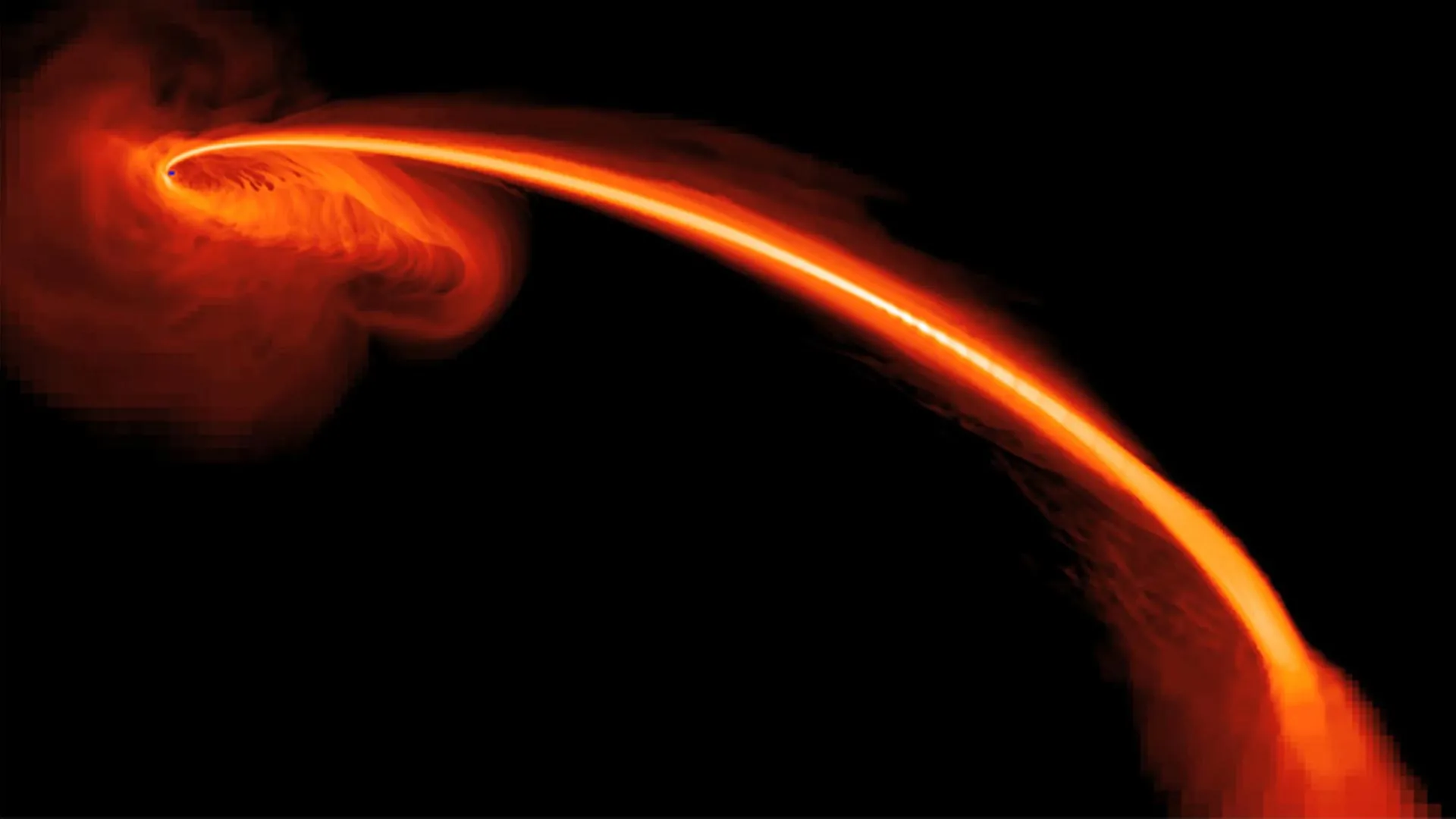
A star’s rapid spin may explain why repeated encounters with a supermassive black hole produce ever-dimmer flashes of light.
Date: August 23, 2026 Source: Syracuse University Summary: Astronomers have found stars that repeatedly skim past supermassive black holes, surviving each encounter while producing a new burst of light. In some systems, those flares mysteriously fade with every return. Researchers now think the key may be stars that were already spinning extremely fast before being captured. That rapid rotation could explain both the fading flares and how the stars ended up in such extraordinarily tight black hole orbits. Share: Facebook Twitter Pinterest LinkedIN Email FULL STORY A hydrodynamical simulation of a star being ripped apart by the tidal forces of a supermassive black hole. Credit: NASA/ S. Gezari (JHU)/ J. Guillochon (UCSC)Most galaxies are thought to harbor a supermassive black hole at their center. These enormous objects can weigh millions or even billions of times more than the sun, creating some of the strongest gravitational environments known in the universe.
When a star passes dangerously close to one of these black holes, destruction is not always immediate. Some stars survive the encounter and return for additional close passes, generating a fresh burst of light each time.
These events, known as repeating partial tidal disruption events (rpTDEs), allow astronomers to observe the same star interacting with the same black hole multiple times. Wide-field time-domain surveys make this possible by repeatedly scanning large regions of the sky and tracking objects whose brightness changes.
Yet some of these systems have presented astronomers with a mystery. Instead of producing similar flares on each return, they become steadily fainter. For years, theoretical models struggled to reproduce that behavior.
New research from astrophysicists at Syracuse University suggests that a previously underappreciated property of the star could provide the answer: how rapidly it was spinning before its first close encounter with the black hole.
The study, published in The Astrophysical Journal, was led by doctoral student Ananya Bandopadhyay, working with postdoctoral researcher Benjamin Amend and associate professor Eric Coughlin, all in the Department of Physics, along with collaborators at other institutions.
How Black Holes Tear Apart Stars
In a standard tidal disruption event (TDE), the gravitational pull from a black hole varies so strongly from one side of a nearby star to the other that the star is completely torn apart.
The resulting stellar debris begins falling toward, or "accretes" onto, the black hole. As that material loses energy, it releases light over periods ranging from days to months.
Black holes themselves do not emit light, but a TDE temporarily supplies material that can illuminate the region around one. That glow gives astronomers an indirect way to investigate objects that would otherwise be invisible.
Not every encounter ends with the star being completely destroyed. If a star passes close to a black hole without crossing the threshold for total disruption, it can lose only part of its mass, producing a partial TDE. During a repeating partial TDE, the star's surviving core remains in orbit and returns for additional close encounters, shedding more material each time. These passages can occur months or several years apart.
Why Some Black Hole Flares Keep Fading
The amount of material stripped from a star during repeated encounters depends in part on the star's internal structure. Bandopadhyay likens a low-mass star to a fluffy meringue. Such a star can become increasingly susceptible to the black hole's tidal forces.
A higher mass star behaves differently. Its material is more concentrated toward the center, with an onion-like internal structure. It can lose its outer layers while its dense core remains comparatively unchanged, causing the amount of mass lost to decrease over successive encounters.
Those structural differences can help explain why not all rpTDEs evolve in the same way. But one observation has been especially difficult to understand. Of the roughly 10 repeating systems identified so far, four have shown flares that become progressively dimmer.
It might seem natural to assume that smaller amounts of stripped material would simply produce weaker flares. Previous hydrodynamical simulations, however, revealed a complication. Even when the star lost less material during each passage, the models still predicted flares with approximately the same peak brightness.
"We were puzzled by this for two years," Bandopadhyay says.
Their previous work uncovered another important consequence of the black hole's tidal forces. Besides pulling material away from the star, those forces also apply torque, causing the star to rotate faster after each close encounter.
That increased rotation changes how quickly stripped material returns toward the black hole. Even though less material comes back, it does so over a shorter period of time. The more concentrated flow helps maintain a similar peak fallback rate, and therefore roughly the same predicted flare brightness.
A Rapidly Spinning Star Changes the Picture
To reproduce the fading flares astronomers actually observe, the researchers needed what Bandopadhyay called "a new ingredient": a star that was already rotating rapidly before its first encounter with the black hole.
The new simulations suggest that such a star cannot be spun up nearly as much during later passages. Without a large increase in rotation after each encounter, the time required for the stripped material to fall back toward the black hole remains relatively steady.
That changes the outcome. As progressively less material is stripped from the star, the peak fallback rate also decreases. The predicted flare can then become fainter with each encounter, matching what astronomers have seen.
How the Star May Have Been Captured
The finding raises another question: Why would a star approaching a supermassive black hole already be spinning so quickly?
"It is also extremely difficult to 'bind' a star to a supermassive black hole so tightly that it orbits the black hole in a matter of months, and yet they seem to do so in rpTDEs," Coughlin says.
A process known as the Hills mechanism may provide an explanation for both the rapid rotation and the star's unusually tight orbit.
In this scenario, two stars orbiting closely around each other approach a supermassive black hole. The black hole's gravity tears the binary system apart. One star is hurled away, while the other is captured into orbit around the black hole.
Stars in a very close binary can become tidally locked, meaning each star rotates on its axis at the same rate that the pair orbits one another. The tighter the binary, the shorter the orbital period and the faster a tidally locked star must rotate.
To leave one captured star on the short orbit observed in rpTDEs, the original binary system would have to be extremely compact. That same tight configuration would naturally produce a rapidly spinning, tidally locked star before the black hole captured it.
"Ananya's work demonstrates that each of these peculiarities can be explained by the same underlying phenomenon: the tidal destruction of a binary system and the capture of one of the stars," Coughlin says. "From a theoretical standpoint, this is a major step forward in our understanding of the physics at play in these systems."
A Possible Connection to the Milky Way
The implications may extend beyond distant repeating flare systems. Coughlin notes that Hills capture may also be responsible for some of the stars now orbiting Sagittarius A*, the supermassive black hole at the center of the Milky Way.
If so, the same mechanism that may explain fading rpTDE flares could also help astronomers understand some of the unusual stellar populations surrounding the black hole in what Coughlin calls "our own cosmological backyard."
Story Source:
Materials provided by Syracuse University. Note: Content may be edited for style and length.
Journal Reference:
- Ananya Bandopadhyay, Benjamin Amend, Eric R. Coughlin, C. J. Nixon, Dheeraj R. Pasham, T. Wevers. The Role of Stellar Spin in Repeating Partial Tidal Disruption Events. The Astrophysical Journal, 2026; 1007 (2): 181 DOI: 10.3847/1538-4357/ae8f31
Cite This Page:
Syracuse University. "Black holes keep tearing these stars apart, but they survive." ScienceDaily. ScienceDaily, 23 August 2026. . Syracuse University. (2026, August 23). Black holes keep tearing these stars apart, but they survive. ScienceDaily. Retrieved August 24, 2026 from www.sciencedaily.com/releases/2026/08/260822015119.htm Syracuse University. "Black holes keep tearing these stars apart, but they survive." ScienceDaily. www.sciencedaily.com/releases/2026/08/260822015119.htm (accessed August 24, 2026).Explore More
from ScienceDaily RELATED STORIES A Star’s Violent Death Exposed a Hidden Supermassive Black Hole Aug. 6, 2026 A supermassive black hole has been found lurking about 30,000 light-years from the center of its galaxy—the first dormant black hole detected so far from a galactic core. It revealed itself only ... Astronomers Discover the Fastest-Feeding Black Hole in the Early Universe Nov. 4, 2024 Astronomers have discovered a supermassive black hole at the center of a galaxy just 1.5 billion years after the Big Bang that is consuming matter at a phenomenal rate -- over 40 times the ... Ravenous Black Hole Consumes Three Earths'-Worth of Star Every Time It Passes Sep. 7, 2023 Massive burst of X-rays detected by astronomers indicates material three times the mass of Earth burning up in a black hole. They observed a star like our own Sun being eaten away every time it ... Astronomers Find No Young Binary Stars Near Milky Way's Black Hole May 11, 2023 Scientists analyzed over a decade's worth of data about 16 young supermassive stars orbiting the supermassive black hole at the center of the Milky Way galaxy. Supermassive stars typically are ... A Star's Unexpected Survival Jan. 13, 2023 Hundreds of millions of light-years away in a distant galaxy, a star orbiting a supermassive black hole is being violently ripped apart under the black hole's immense gravitational pull. As the ... Deepest Images Yet of Milky Way's Supermassive Black Hole Dec. 14, 2021 Astronomers have obtained the deepest and sharpest images to date of the region around the supermassive black hole at the center of our galaxy. The new images zoom in 20 times more than what was ... TRENDING AT SCITECHDAILY.comDogs and Humans May Share a Surprising Biological Secret to Longevity
Cleaner Cars May Be Hiding a New Pollution Problem
Scientists Uncover Signs of an Ancient Climate “Tipping Point”
236-Million-Year-Old Fossil Reveals a Stunning Secret About the Origins of Mammal Birth
Print Email ShareBreaking
this hour- Common Drugs May Change Your Gut for Years
- Your Bird Feeder Could Spread Bird Flu
- Ghostly Star Stream Maps Dark Matter
- A Sleep Sweet Spot for Slower Aging
- Screen Time at Ages 1 and 6 Matters
- Mapping a Molecule’s Quantum Shape
- NASA’s Roman Telescope Is Ready to Launch
- Artemis II Astronauts Earn Major Honor
- Tiny New “Dragon” Discovered in Thailand
- Alzheimer’s Gene May Shrink Neurons
Trending Topics
this week SPACE & TIME Asteroids, Comets and Meteors Dark Matter Extrasolar Planets MATTER & ENERGY Construction Engineering and Construction Technology COMPUTERS & MATH Computer Modeling Neural Interfaces CommunicationsStrange & Offbeat
SPACE & TIME Physicists Create a Tiny “Big Bang” With Surprisingly Small Atomic Nuclei Black Holes Keep Tearing These Stars Apart, but They Survive A SpaceX Rocket Smashed Into the Moon — NASA Just Revealed the Crater MATTER & ENERGY Scientists May Have Finally Proved That “empty” Space Isn’t Really Empty Ordinary WiFi Can Now Identify You With Near-Perfect Accuracy A Tiny Universe in a Bottle Reveals Clues to the Origins of Life COMPUTERS & MATH Tiny Robots Powered by Light Can Hunt Down and Collect Bacteria Scientists Turn DNA Into a Memory Device That Uses 100x Less Power Claude Fable 5 AI Finds a Tiny Formula That Topples an 87-Year-Old Math Conjecture\n